The History of Dade City, Florida
From an 1835 frontier battle that ignited the Second Seminole War, to a railroad town that became the seat of Pasco County, to a courthouse square famous for kumquats — the story of historic Dade City.
Named For
Maj. Dade
Founded
1884
County Seat
Since 1887
Population
≈ 8,600
The Name
An Army Major and a Florida Battle
The name Dade on every street sign and county building in this part of Florida traces back to one man and one terrible afternoon. Major Francis L. Dade was a Brevet Major in Company B of the 4th U.S. Infantry, leading roughly 110 soldiers north from Fort Brooke (modern Tampa) toward Fort King (modern Ocala) in late 1835.
On December 28, 1835, just east of present-day Bushnell, his column was ambushed by Seminole warriors. Only three of Dade's men survived. The engagement — the Dade Battle, often called the “Dade Massacre” — opened the Second Seminole War, the longest and costliest of the Indian wars fought on American soil.
A year later, on December 23, 1836, the Army built a stockade in this area and named it Fort Dade in his memory. When a railroad eventually bypassed the original site, the town — newly incorporated — kept the name.
Historic Photo
Major Francis L. Dade, 4th U.S. Infantry (c. 1835)
The shot heard from beneath a Florida pine in 1835 echoed for seven years — and gave a name to a town built nearly fifty years later on the same frontier.
From Fort to City
The Town the Railroad Built
Settlement around old Fort Dade grew slowly through the 1840s and 1850s. Thomas R. Tucker and Sarah Tucker were the first known white settlers in what would become Pasco County; in December 1842, James Gibbons received a federal land permit for 160 acres that ultimately became the heart of Dade City. A Fort Dade post office opened in 1845 with Gibbons as postmaster.
The town as we know it today was born after the Civil War. A group of Civil War veterans from Kentucky began homesteading in the area in the 1870s. When the railroad surveyed its route eastward in the 1880s, it ran a few miles east of the old Fort Dade settlement — so the entire community pulled up stakes and moved to meet the rails. On December 18, 1884, the local Hatton post office was renamed Dade City, and the town incorporated soon after. Reincorporation as a city followed on June 5, 1889.
When Pasco County was carved out of southern Hernando County by the Florida Legislature in 1887, Dade City became the county seat — first temporarily, and then permanently by popular vote.
Post office renamed
1884
Hatton → Dade City
Reincorporated
1889
As a city
County Seat
1887
Of new Pasco County
Centerpiece of the Square
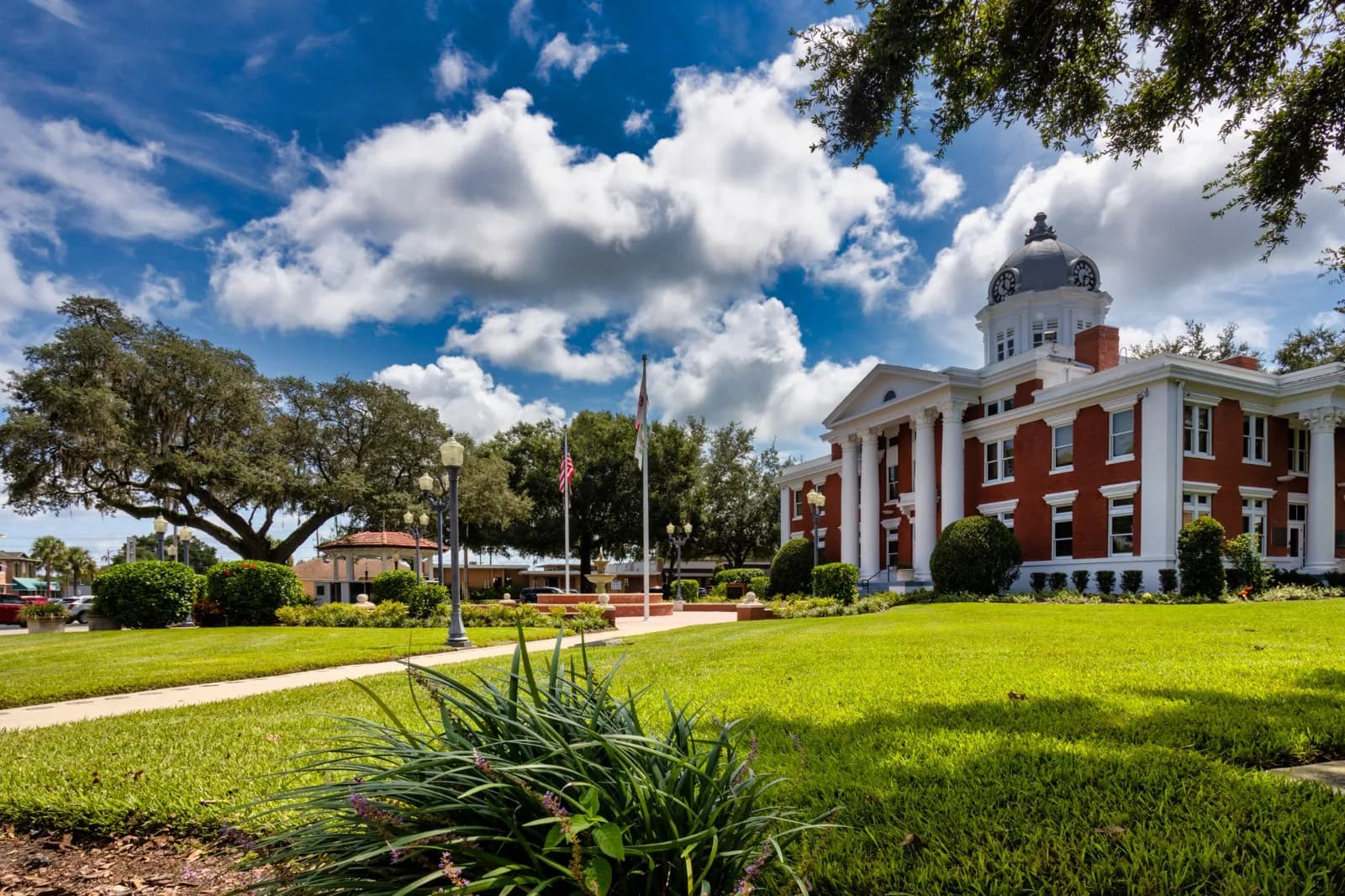
The 1909 Pasco County Courthouse
World War II
A German POW Camp in the Pines
From 1942 to 1946, Dade City hosted a German Prisoner of War campon the eastern edge of town. Most of the prisoners had been captured in North Africa as part of Field Marshal Erwin Rommel's Afrika Korps and shipped across the Atlantic to ride out the war on Florida farms and citrus groves.
POWs in Dade City worked the local fields and groves under agreements between the federal government and area growers. After the war, the camp closed and was demolished. Today the site is home to Pyracantha Park Civic Center, with little obvious sign of its wartime past — a quiet footnote in a town whose name itself was forged in an earlier American war.
The Kumquat Capital
40,000 People for One Tiny Citrus
The sandy uplands around Dade City turned out to be ideal for one of the world's smallest citrus fruits — the kumquat. Growers have been cultivating them in the area since the late 1800s, and today the region is one of the largest commercial kumquat-producing areas in the United States.
That heritage is celebrated every January at the Annual Kumquat Festival, held on the streets surrounding the historic courthouse. The festival draws up to 40,000 visitors in a single day for live music, kumquat pies, marmalades, and a downtown that swells from sleepy to packed.
The Kumquat Festival shares the courthouse square with the long-running Dade City Cruise-In, a vintage car show that turns the streets into rolling history every season.
A Town's Milestones
A Walk Through Nearly Two Centuries
Dec 28, 1835
The Dade Battle opens the Second Seminole War
Dec 23, 1836
Fort Dade established
Dec 1842
The first homestead permit
1845
Fort Dade post office opens
1870s
Civil War veterans arrive from Kentucky
Dec 18, 1884
The town becomes Dade City
1887
Pasco County is born
Jun 5, 1889
Reincorporated as a city
1904
Hugh Embry Library opens
1909
The Pasco County Courthouse rises
1942–1946
A German POW camp in town
Sep 1, 1975
Pioneer Florida Museum opens
1990s
Kumquat Festival becomes a regional draw
May 30, 2023
Hugh Embry Library reopens
Dade City Today
The County Seat in the 2020s
Population (2020)
7,275
U.S. Census
2023 Estimate
≈ 8,646
And growing
Land Area
7.81 sq mi
City limits
Elevation
118 ft
Among Florida's highest
Geography, People & Economy
Dade City sits at the crossroads of U.S. 98, U.S. 301, and the new alignment of State Road 52 — the same SR-52 extension that opened in 2023 connecting San Antonio and the western Pasco communities directly to the Dade City courthouse square. The 2020 Census recorded 7,275 residents, with a 2023 estimate of about 8,646. Demographics run roughly 52.6% White (non-Hispanic), 25.6% Hispanic or Latino, and 17.4% Black or African American.
The economy mixes agriculture (citrus, including kumquats), healthcare anchored by AdventHealth Dade City, county government and the courthouse complex, and a growing downtown of independent restaurants, antique stores, breweries, and seasonal events.
City Government
A Commission–Manager Form
Dade City operates under a commission–manager form of government. An elected mayor and four city commissioners set policy, while a professional city manager handles day-to-day operations from City Hall on the courthouse square.
Mayor
Scott Black
Chief Elected Official
Mayor Pro Tem
Normita "Angel" Woodard
City Commissioner
City Manager
Marieke vanErven
Day-to-Day Operations
Commissioner
Kristin H. Church
Commissioner
Ann E. Cosentino
Commissioner
James D. Shive
On the Map
Where Dade City Sits
Dade City, Florida — eastern Pasco County, on US 98 and US 301.
Walk the History
Six Places to See It for Yourself
Pasco County Courthouse
The 1909 white-domed centerpiece of the downtown square. Listed on the National Register of Historic Places.
Pioneer Florida Museum
Just outside town: a 1913 locomotive, antebellum house, one-room schoolhouse, Trilby depot, and Methodist church.
Hugh Embry Library
Established 1904, renovated and reopened May 2023. Among the oldest libraries in Pasco County.
Kumquat Festival
Held each January around the courthouse square — up to 40,000 visitors and the world's smallest citrus.
Pyracantha Park Civic Center
On the site of the WWII German POW camp that once held Afrika Korps prisoners.
Historic Downtown Dade City
Brick storefronts, antique stores, restaurants, and breweries surrounding the courthouse — a county seat that kept its character.