The History of Dade City, Florida
From a frontier post named after a fallen Army major to the bustling county seat of Pasco County, Dade City has lived through nearly two centuries of war, railroad booms, citrus harvests, prisoner-of-war camps, hurricane floods, and now one of the fastest population surges in its history. The story of how this east Pasco town became what it is today is a story of constant reinvention — and of a community still trying to decide what it wants to become next.
A Town Born From Conflict
Long before there was a Dade City, the rolling hills of east Pasco belonged to the Tocobaga people, whose villages once stretched across the northern reaches of the Tampa Bay region. By the early 1800s, the area had become contested ground in Florida’s long and violent conflicts between the U.S. Army and the Seminole nation.
The town’s name traces directly to that struggle. On December 28, 1835, U.S. Army Major Francis L. Dade was killed alongside most of the soldiers he was leading from Fort Brooke, in what is now Tampa, to Fort King near present-day Ocala. The ambush, often referred to as the Dade Battle, helped ignite the Second Seminole War.
One year later, in December 1836, the Army built a small outpost a short distance from the present downtown and named it Fort Dade in his honor. By 1842, James Gibbons had been issued a 160-acre land permit in the area, and three years later he became the postmaster of the original Fort Dade post office, established in his home in 1845.
The Railroad That Moved a Town
For decades, Fort Dade remained a remote pioneer settlement. The turning point came in 1884, when railroad construction passed a few miles east of the original community. Rather than be left behind, business owners and residents simply picked up and relocated next to the new rail line.
The rebuilt town took the name Dade City when the Hatton post office officially became the Dade City post office on December 18, 1884. Some accounts list the original incorporation that same year, others in 1885, but state lawmakers reincorporated the community as a city on June 5, 1889 — the date most historians treat as the formal founding of modern Dade City.
- 1835: Major Francis L. Dade killed in the Dade Battle, sparking the Second Seminole War.
- 1836: Fort Dade established near present-day Dade City.
- 1845: Fort Dade post office opens in James Gibbons’ home.
- 1884: Railroad arrives; town relocates and renames itself Dade City.
- 1887: Pasco County is created from southern Hernando County.
- 1889: Dade City is reincorporated as a city by state legislative approval.
- 1909: Historic Pasco County Courthouse is built.
Becoming the Pasco County Seat
In 1887, the Florida Legislature carved Pasco County out of the southern half of Hernando County, naming the new county after U.S. Senator Samuel Pasco. Dade City was selected as the county seat, first temporarily and later permanently by popular vote. That decision shaped the city’s identity for the next century and a half.
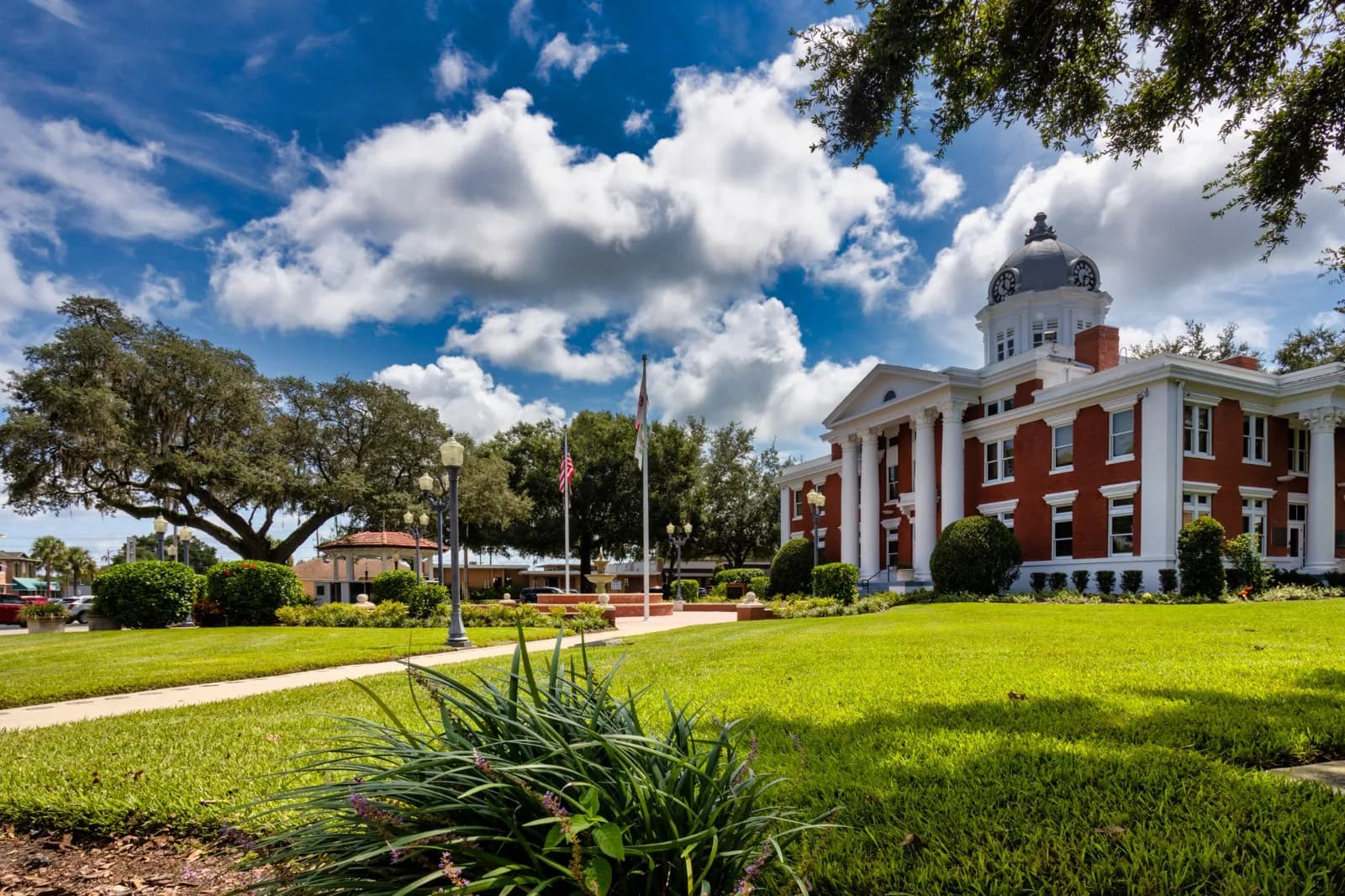
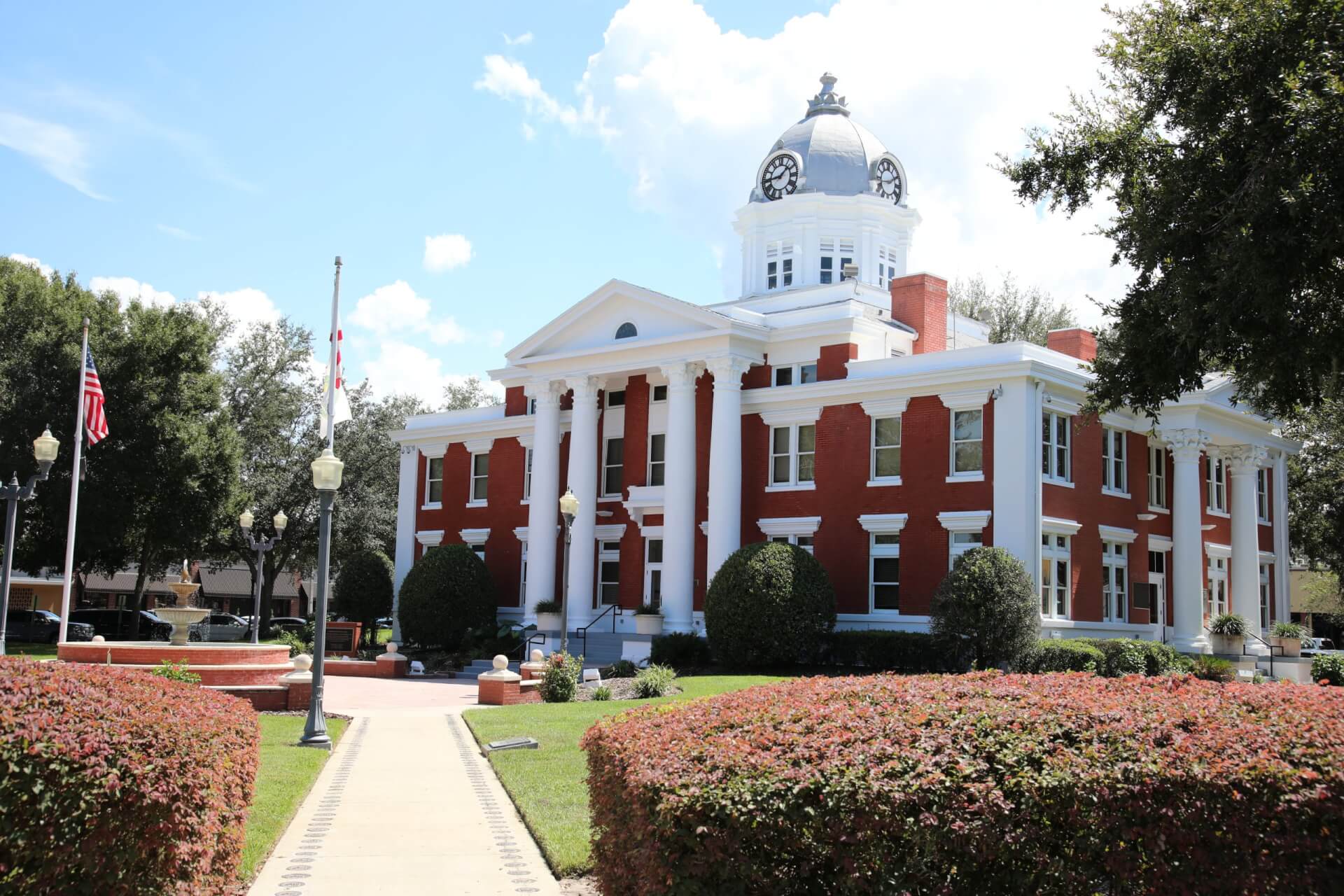
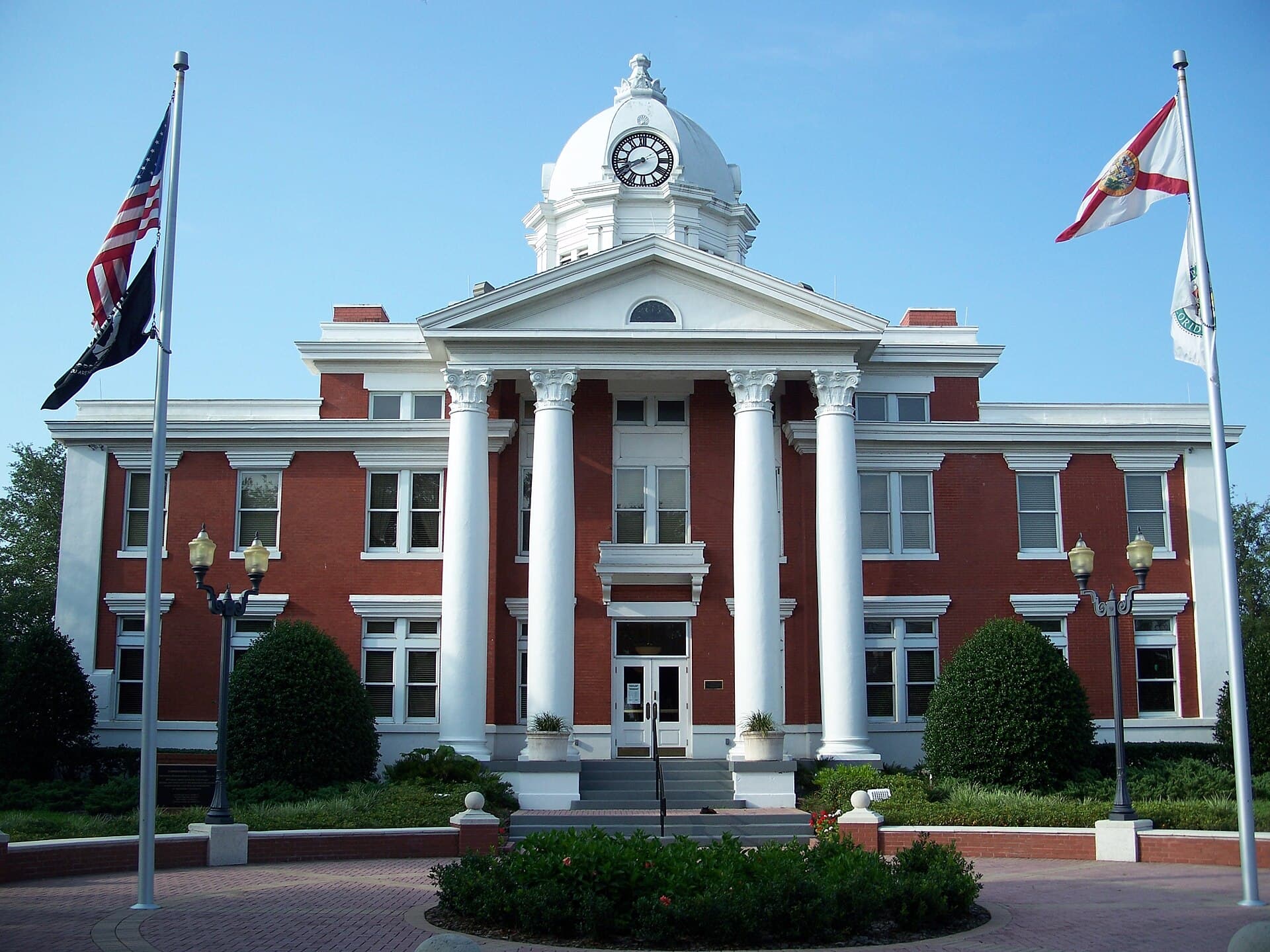
The historic Pasco County Courthouse, designed by architect Artemus Roberts in a two-story Beaux-Arts style, was completed in 1909 and still stands as the centerpiece of downtown Dade City at the corner of 7th Street and Meridian Avenue. The 1921 bandshell on the courthouse square remains a recognizable local landmark, and a relatively new Valentine’s Day tradition has the county clerk performing free wedding ceremonies on the courthouse steps each February.
Citrus, the Land Boom, and the “Two-Class” Economy
By the early 20th century, Dade City had become a hub for citrus, cattle, and cross-county commerce. Two railroads served the town. Hotels, banks, churches and Victorian homes went up along Church Avenue and the surrounding blocks. The Hugh Embry Library opened in 1904, named for a young man who began collecting books for the community while recovering from illness.
Then came the Florida land boom of the 1920s. Property values climbed, real estate offices multiplied, and longtime resident and former mayor Lawrence Puckett later wrote that Dade City’s top moneymaking ventures during the boom were real estate, real estate–adjacent businesses, and moonshine. Puckett described the town of his youth as a typical southern agricultural community where a small group of well-off families largely controlled the economy while many residents lived in deep poverty — a divide that shaped Dade City for generations.
The Crescent Theatre opened on the corner of South 5th Street and Florida Avenue in 1926 and was the town’s main movie house until it closed in 1950. The Pasco Theatre on South 7th Street followed in 1948 and operated until its demolition in 1999, though the original “PASCO” sign now hangs inside Florida Cracker Lunch on Limoges, one of downtown’s best-known restaurants.
A POW Camp in the Pines
One of the more unusual chapters in Dade City’s history played out during World War II. From 1942 to 1946, the city was home to a prisoner-of-war camp that held German soldiers captured in North Africa as part of Field Marshal Erwin Rommel’s Afrika Korps. The site of that camp is now Pyracantha Park Civic Center, used for community events and recreation.
Across town, daily life largely revolved around the courthouse, the railroad depot, the citrus packinghouses, and the small downtown square. Passenger trains served Dade City’s Atlantic Coast Line depot for decades, and CSX freight trains still rumble through town today on the Wildwood Subdivision.
The Quiet Decades
For much of the second half of the 20th century, Dade City stayed small. The Pioneer Florida Museum and Village opened on the east edge of town on Labor Day 1975, preserving a 1913 locomotive, an antebellum house, an old schoolhouse, a Methodist church, and the historic train depot moved in from nearby Trilby. The Hugh Embry Library moved to its current 4th Street location in 1963 and was rebuilt as a 7,200-square-foot facility in 1991.
Through the 1980s and 1990s, the population stayed under 7,000. Antique shops, churches, citrus groves, and the courthouse remained the heart of the community. The annual Kumquat Festival, which celebrates the small tart citrus fruit grown widely in the surrounding hills, became a signature winter tradition that still draws tens of thousands of visitors to downtown each year.
A Population That Suddenly Took Off
For most of its history, Dade City’s population grew slowly, and at times even shrank. From 2000 to 2010, the city actually lost residents. That changed dramatically after 2020.
According to U.S. Census Bureau estimates, Dade City’s population grew by more than 50 percent between the 2020 census and 2026. Recent figures put the city at roughly 10,873 residents and climbing at an annual rate near 5.9 percent — among the fastest growth rates of any small city in the Tampa Bay region.
A City Divided Over What Comes Next
The growth has not arrived quietly. Hundreds of new homes are under construction along Prospect Road and Handcart Road, where Stanley Martin Homes is building a roughly 400-home community and Casa Fresca Homes is developing another neighborhood just down the road. Larger projects approved earlier in the decade include a 700-home Phase 1 community already greenlit by the City Commission and a 370-home Phase 2 expansion that drew significant pushback from neighbors.
Outside the city limits, Pasco County’s plans for an employment center and mixed-use development near the Blanton Road interchange at Interstate 75 have drawn similar resistance. Residents in the rural Jessamine and Blanton areas have argued that suburban-scale projects do not belong in long-established farming communities, while county officials have pointed out that the future land-use designation for that area has been on the books since 2006.
Dade City sits at one of Florida’s sharpest growth fault lines. Newcomers see opportunity, jobs, and long-overdue retail. Longtime residents see traffic, lost farmland, and a small-town character that may not survive another decade of unchecked development. How the City Commission and Pasco County leaders balance those views will shape the city for generations.
Conversations with residents around town capture the divide clearly. Some welcome the prospect of more jobs, better grocery options, and amenities they currently have to drive to Wesley Chapel or Zephyrhills to find. Others worry that the very things that drew them to Dade City — the rolling hills, the quiet roads, the acreage, the citrus groves — are being chipped away one approval at a time. Recent City Commission candidates have made “managing growth” the central issue of their campaigns, and city leaders have wrestled with aging infrastructure, an overdue wastewater treatment facility, and ongoing odor complaints near the Dade City Business Center.
Hurricanes, Floods, and the Withlacoochee
The other story shaping recent years has been the weather. Although Dade City sits inland and at a relatively high elevation for Florida — about 135 feet above sea level — the city and surrounding area have been hammered by an unusual run of tropical systems.
Hurricane Idalia struck the Big Bend in August 2023 and brought heavy rain to east Pasco. Hurricane Debby followed in early August 2024, dumping more rainfall on already-saturated ground. Then came the back-to-back blow of Hurricane Helene, which made landfall as a Category 4 storm on September 26, 2024, and Hurricane Milton, which roared ashore as a Category 3 on October 9, 2024.
Milton was the storm that hit Dade City the hardest. According to information released by the Southwest Florida Water Management District, parts of the Green Swamp received close to 16 inches of rain in a single overnight period at the end of an already wet season. With the Withlacoochee River’s headwaters overwhelmed, the river surged to levels not seen in more than six decades.
| Withlacoochee River Site | Milton Crest (Oct. 2024) | Comparison |
|---|---|---|
| Trilby (US 301) near Dade City | 19.6 feet | Surpassed 2017 Hurricane Irma peak |
| SR 471, Green Swamp | Highest in 60+ years | Above 1960, 2004 and 2017 peaks |
| Dade City gauge (west Green Swamp) | +5.5 feet in 3 days | Historic flooding |
| Ridge Manor (SR 50) | +6 feet since Milton | Highest since 1960 |
The flooding destroyed homes along the Withlacoochee. According to news coverage at the time, one Dade City family lost their home entirely as the river kept rising for days after the storm had passed. The Florida National Guard’s Crisis Response Battalion set up a point of distribution in Dade City to hand out supplies, and the state deployed floodwater pumps and rescue teams to nearby Zephyrhills.
Withlacoochee River Electric Cooperative, which is headquartered in Dade City and serves roughly 270,000 members across five central Florida counties, was hit hard. According to the cooperative’s own account of the storm, water poured through the lower floor of its Dade City control center, communications to substations were knocked out, and giant oak trees that had shaded the headquarters for generations were lost.
The Dade City of Today
Despite the storms and the growing pains, Dade City still feels unmistakably itself. The historic Pasco County Courthouse anchors a downtown lined with antique shops, restaurants like Kafe Kokopelli in the 1916 Ford Motor store and Lunch on Limoges in the 1908 O.N. Williams Department Store, and dozens of buildings that have been reimagined for the 21st century. A self-guided historical walking tour developed by local historians includes 82 stops, ranging from the 1886 Saint Paul Missionary Baptist Church to the 1889 Bank of Pasco, now a Wells Fargo branch.
The Pioneer Florida Museum and Village still draws visitors to its restored buildings and locomotive. The Pasco-Hernando State College East Campus continues to anchor higher education in east Pasco. AdventHealth Dade City keeps a hospital footprint inside the city. The Kumquat Festival, the Christmas Parade, the Dade City Cruise-In car show on the courthouse square, and the rural farms of Lake Jovita and Blanton remind residents of where the community came from, even as new subdivisions rise along Handcart Road and US-301.
Looking Ahead
Nearly 200 years after Major Dade rode out of Fort Brooke, the town that bears his name is once again at a crossroads. The Pasco County seat is growing faster than it has in living memory. Floods that hadn’t hit in six decades have hit twice in two years. New residents are moving in for the same small-town character that longtime locals worry is being paved over. How Dade City handles those competing pressures — growth, preservation, infrastructure, and resilience — will write the next chapter of a history that has been anything but quiet.
For more local news, history, and updates from across east Pasco County, stay with Dade City Community at dadecitycommunity.com.
Continue this story for free.
Stay informed about Dade City. Enter your email to access the full story and receive local news and community updates.
Free to read · No password to remember
New here? We’ll email you a sign-in link and code. Already a reader? Use your usual email.
Read next
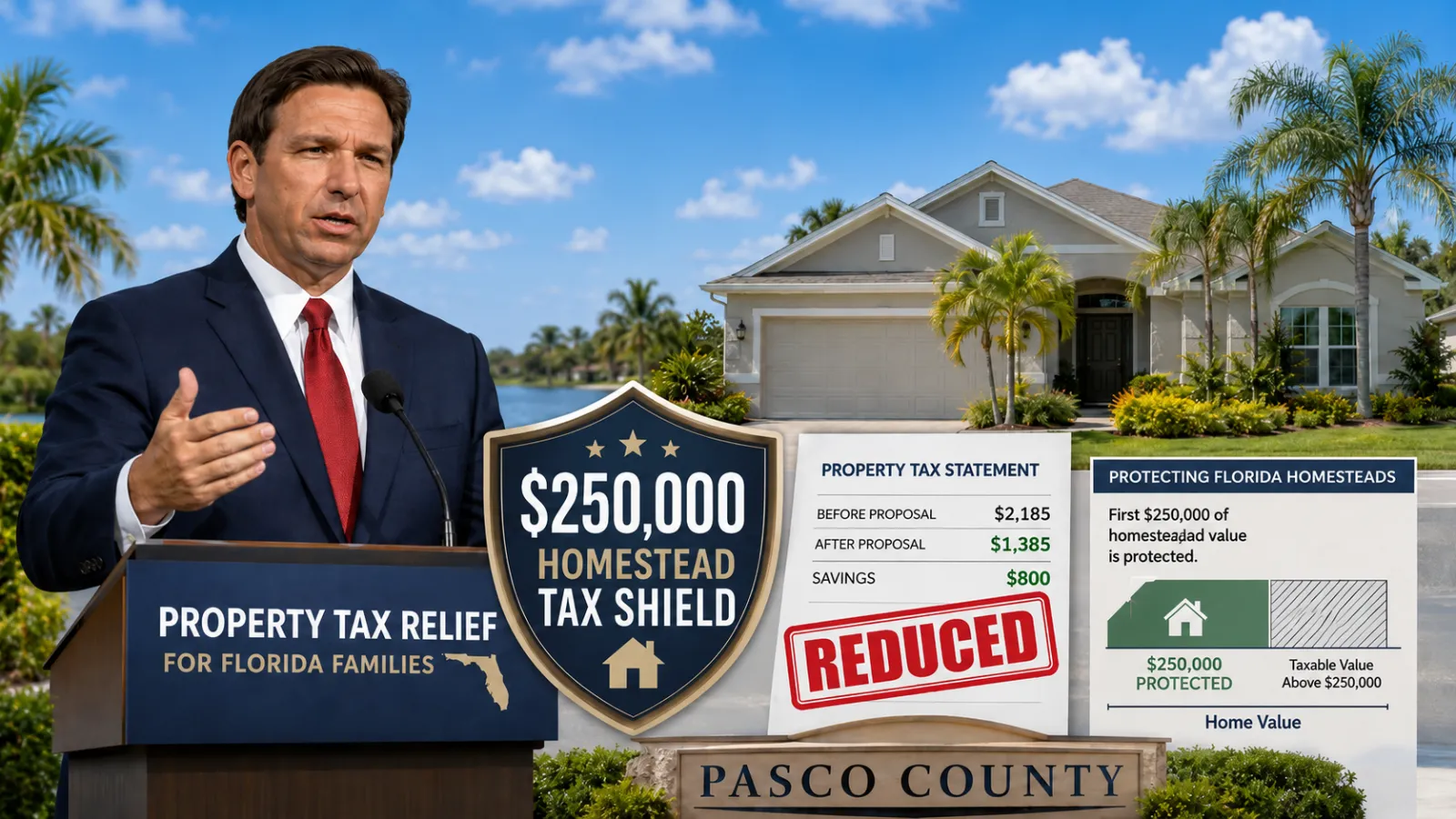
How Much Could Pasco Homeowners Save Under DeSantis’s Property Tax Plan? We Ran the Numbers
Read the story ↗
Stay connected with Dade City
Follow us for the latest community news and updates
Comments
What does this mean for your neighborhood? Share your experience or ask a question.
Your draft stays here while you sign in. Be respectful and keep it local.
No comments yet. Be the first to share your thoughts!